Lab 7















1.0 Introduction
Welcome to this hands-on workshop on buildings detection detection using the Geospatial Studio! This tutorial will guide you through the complete workflow of fine-tuning a geospatial foundation model and running inference to identify buildings detections from satellite imagery.
What you'll learn:
- Setting up and connecting to the Geospatial Studio platform
- Fine-tuning models for buildings detection segmentation tasks with pre-trained foundation models and datasets
- Running inference on real-world Buildings Detection data (Austin, Texas)
- Visualizing and analyzing results in the Studio UI
- Comparing results with a better trained model
Prerequisites:
- A deployed instance of the Geospatial Studio
- Access to GPU resources (for fine-tuning section)
- Basic familiarity with Python and Jupyter notebooks
1.0.1 Understanding the Workflow
Before we begin, the complete workflow is as follows:
Key Components:
- Foundation Model (Backbone): Pre-trained model with general geospatial understanding
- Training Dataset: Labeled data for your specific task
- Task Template: Configuration defining the learning task
- Fine-tuning Job: Training process that customizes the model
- Trained Model (Tune): Your custom model checkpoint
- Inference: Running predictions on new data
1.0.2 Example: Buildings Detection Detection Workflow
Below is an example of what you'll achieve in this workshop - detecting buildings from satellite imagery using fine-tuned geospatial foundation models.
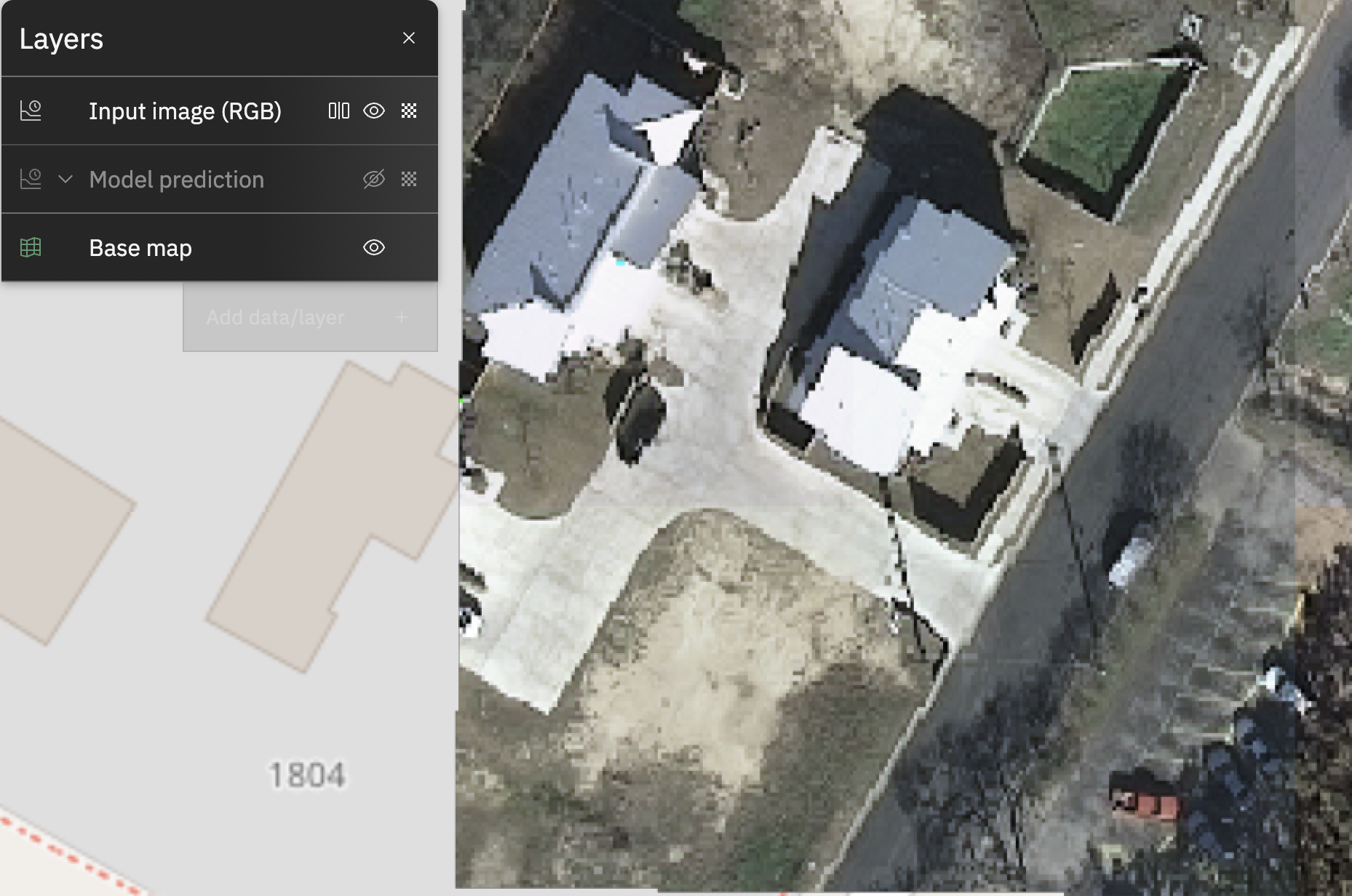
Input Satellite Imagery
Raw satellite data showing labelled buildings:
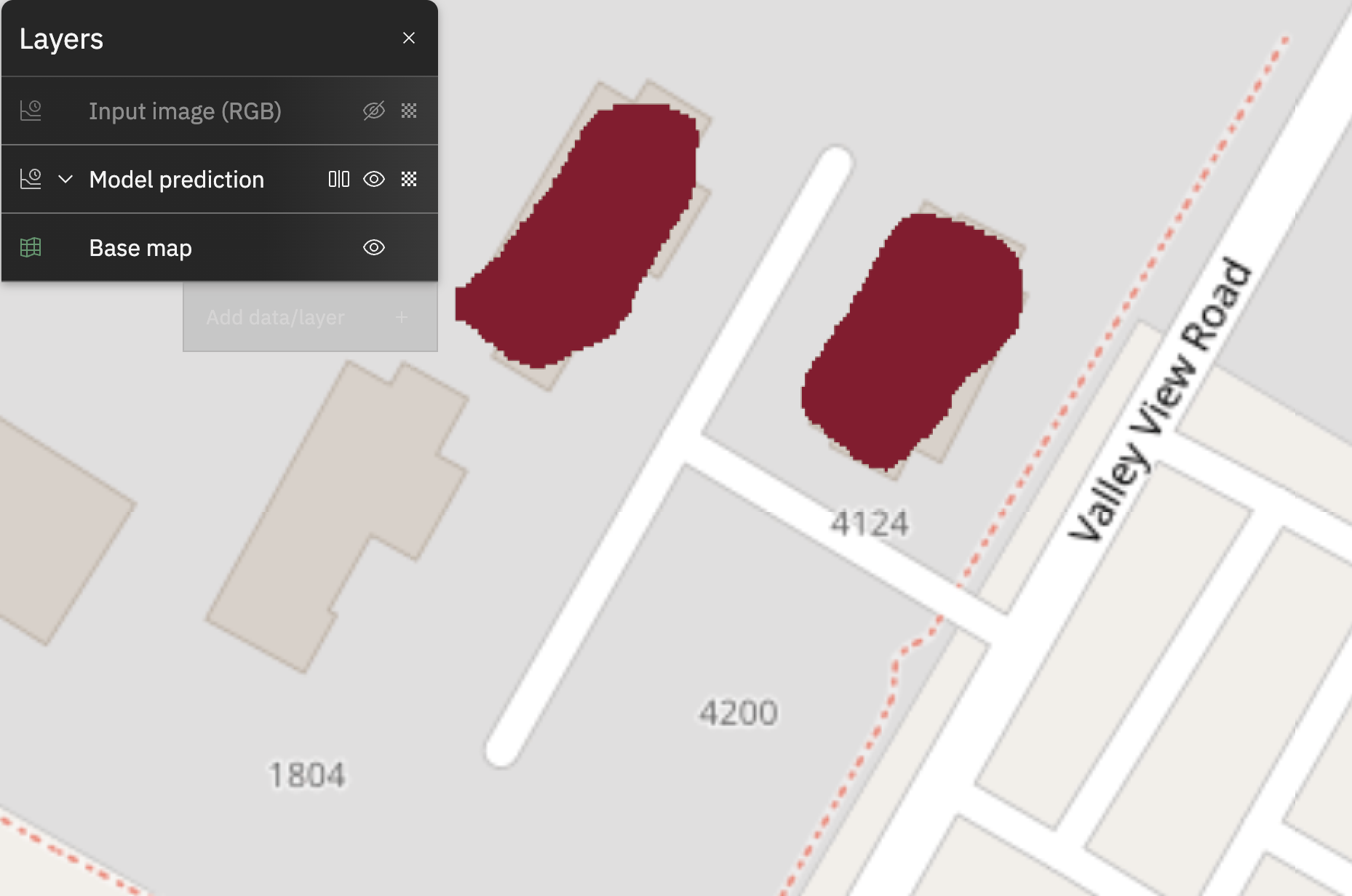
Model Prediction
The fine-tuned model identifies buildings :
Prediction Overlay
Buildings predictions overlaid on the original imagery for validation:
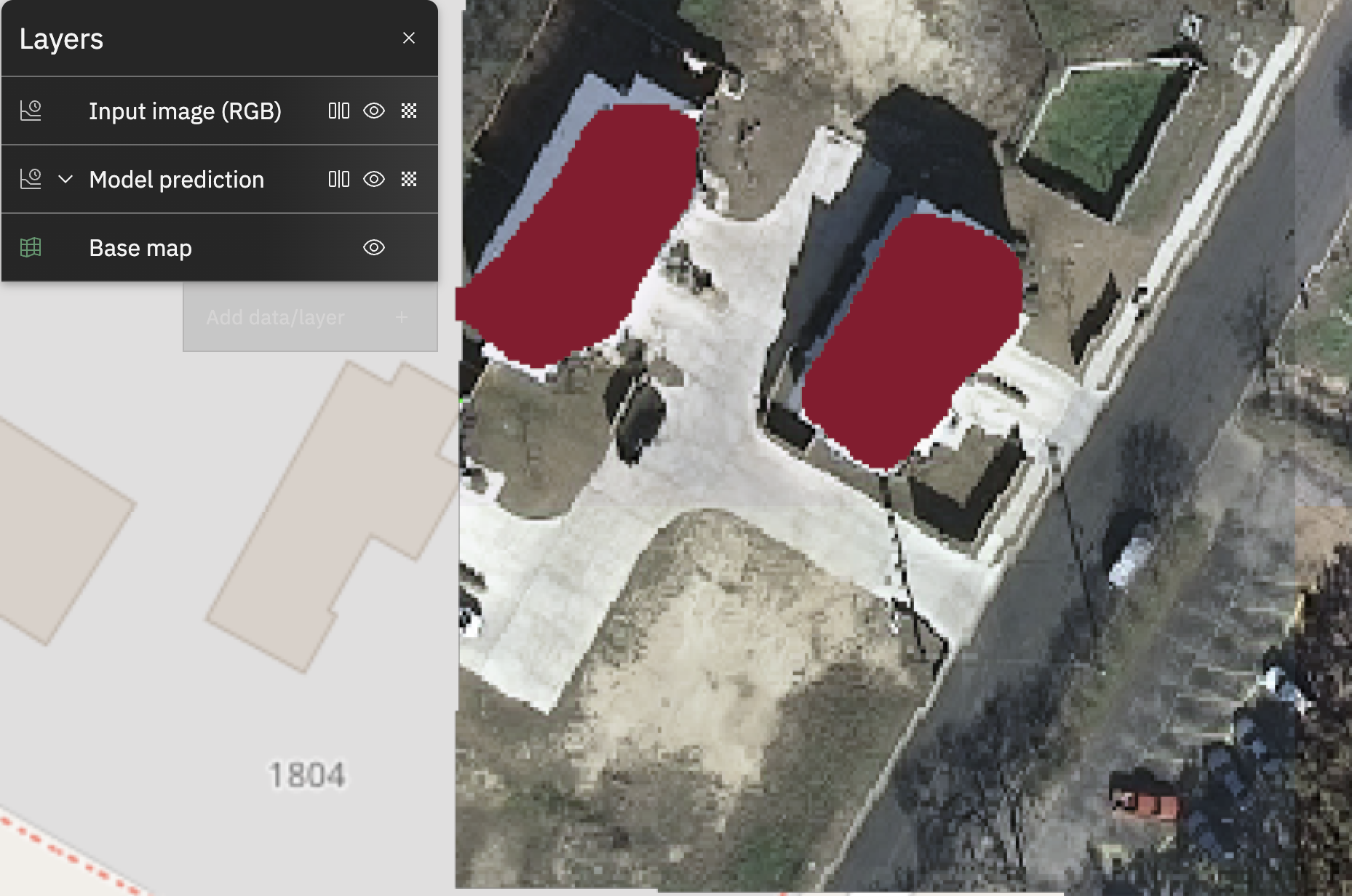
This workflow demonstrates the power of geospatial foundation models in identifying buildings which is crucial for disaster response, environmental monitoring, and recovery planning.
Let's get started by setting up your environment and connecting to the platform!
1.1 Set up and Installation
1.1.0 Prerequisites
Create a python environment
python -m venv venv
OR # depending on your available python version
python3 -m venv venv
source venv/bin/activate
Install geostudio sdk
pip install geostudio
Set the jupyter notebook kernel to point to the above created python environment.
1.1.1 Import required packages
%load_ext autoreload
%autoreload 2
# Import the required packages
import json
import urllib3
urllib3.disable_warnings(urllib3.exceptions.InsecureRequestWarning)
from geostudio import Client
1.2 Connecting to the platform
First, we set up the connection to the platform backend. To do this we need the base url for the studio UI and an API key.
To get an API Key:
- Go to the provided cluster url of the deployed version of the Geospatial Studio UI page
[hrl to be provided here] and navigate to the Manage your API keys link. - This should pop-up a window where you can generate, access and delete your api keys. NB: every user is limited to a maximum of two activate api keys at any one time.
Store the API key and geostudio ui base url in a credentials file locally, for example in /User/bob/.geostudio_config_file. You can do this by:
echo "GEOSTUDIO_API_KEY=<paste_api_key_here>" > .geostudio_config_file
echo "BASE_STUDIO_UI_URL=<paste_ui_base_url_here>" >> .geostudio_config_file
Copy and paste the file path to this credentials file in call below. You will need to ensure that the geostudio_config_file is accessible and correctly configured. If you encounter any issues, please verify the file path and contents of the .geostudio_config_file to ensure they are accurate and up-to-date.
#############################################################
# Initialize Geostudio client using a geostudio config file
#############################################################
gfm_client = Client(geostudio_config_file=".geostudio_config_file")
2.0 Burnscars dataset
2.1 Reviewing already prepared and onboarded buildings detection dataset
In this section, we'll explore how to review datasets that have already been prepared and onboarded to the Geospatial Studio. This is useful for understanding what data is available before starting a fine-tuning task.
from pandas import DataFrame


# List all available datasets in the studio
datasets = gfm_client.list_datasets(output='df')
datasets
# Get detailed information about a specific buildings detections dataset
# If you know the dataset name or ID, you can retrieve its details
buildings_detection_dataset_id = "geodata-mtst5e5yh8zdg3azhcj6he"
buildings_detection_dataset_id
# Get detailed metadata for a specific dataset
# Replace with your actual dataset_id from the list above
dataset_details = gfm_client.get_dataset(buildings_detection_dataset_id)
print(json.dumps(dataset_details, indent=2))
From the above output, the dataset Configuration is:
- 3 spectral bands: Red Green Blue
- 2 label categories: Buildings (1), No Building (0)
- File format: GeoTIFF with
_label.tifsuffix for labels - Purpose: Segmentation (pixel-level classification)
3.0 Run a model training job
To ran a Finetuning job, we need:
- A base model
- A dataset
- A task template
3.1 Select a Base Model
For this task, we will use the ConvNeXt foundation model as our base model.
About ConvNeXt:
- Modern pure convolutional neural network architecture
- Designed to compete with Vision Transformers while maintaining ConvNet simplicity
- Incorporates design principles from Transformers:
- Macro design inspired by Swin Transformer
- Depthwise convolutions
- Inverted bottleneck design
- Large kernel sizes (7×7)
- Layer normalization and GELU activation
- Efficient and scalable for various computer vision tasks
- Strong performance on image classification, object detection, and segmentation
- Pre-trained on ImageNet and adaptable to geospatial imagery
The backbone configuration includes:
- Model architecture: Pure convolutional network with modern design
- Key features: Depthwise convolutions, large kernels, inverted bottlenecks
- Activation: GELU (Gaussian Error Linear Unit)
- Normalization: Layer normalization
- Model family: ConvNeXt by Meta AI Research
# List all the base models onboarded in the cluster
base_models = gfm_client.list_base_models(output='df')
base_models
# Select Prithvi_EO_V2_300M model
convnext_base_model_id = "69791dd1-cb10-440a-a34f-f4c00bf74697"
3.2 Select a task template
A task template defines:
- The type of ML task (segmentation, regression, classification)
- Model architecture options
- Training hyperparameters
- Default configurations
Why Do We Need It?
When you upload a model checkpoint, GEOStudio needs to know:
- What task the model was trained for
- How to configure the model for inference
- What inputs the model expects
Available Task Types
- Segmentation - Pixel-wise classification (floods, buildings detection, land cover)
- Regression - Continuous value prediction (biomass, temperature)
- Classification - Image-level labels (crop type, building detection)
- User-Defined - Specific User defined templates for specific model use cases (convnext-template)
For this example, we will be using the ** Convext Segmentation** task type.
# List all the templates onboarded in the cluster
tune_templates = gfm_client.list_tune_templates(output='df')
tune_templates

# Select segmentation template
convnext_segmentation_template_id = "83fd6d96-2f25-4293-b6a7-f47d86724549"
3.3 Submit the training job
- Base Model: Prithvi-EO-V2-300M
- Dataset: buildings detection training data
- Task Template: Segmentation template
- Name: burn-scars-demo
# Create the fine-tuning payload
payload = {
    "name": "building-detection-demo",
    "description": "Segmentation model for Buildings Detection detection",
    "dataset_id": buildings_detection_dataset_id,
    "base_model_id": convnext_base_model_id,
    "tune_template_id": convnext_segmentation_template_id,
    "model_parameters": {
    "runner": {
      "max_epochs": 2
     	}
   }
}

print("📋 Fine-Tuning Configuration:")
print(json.dumps(payload, indent=2))
# Submit the fine-tuning job
print("\n🚀 Submitting fine-tuning job...\n")

tune_submitted = gfm_client.submit_tune(payload, output='json')

print("✅ Fine-tuning job submitted successfully!")
print(json.dumps(tune_submitted, indent=2))

# Save the tune ID for later use
tune_id = tune_submitted['tune_id']
print(f"\n📌 Tune ID: {tune_id}")
print("\nYou can monitor progress in the Studio UI under 'Start fine-tuning' > 'Model & Tunes'")
4.0: Monitor Training Progress
Training a geospatial foundation model takes time. We'll poll the status until completion.
What's happening during training:
- Initialization: Loading base model and dataset
- Training: Iterating through epochs, updating model weights
- Validation: Evaluating performance on validation set
- Checkpointing: Saving model state periodically
- Completion: Finalizing and storing the trained model
Expected Duration:
- Modern GPU (V100/A100): 30-45 minutes
- Older GPU: 45-90 minutes
- CPU: Not recommended (2 hrs + Using Terramind tiny )
Monitoring Options:
- SDK Polling (below): Automated status checks (Not recommended, use Studio UI instead)
- Studio UI: Visual progress tracking with metrics
print("\n⚠️  IMPORTANT: Use the Studio UI to monitor training progress.")
print("The SDK polling is for automation only - it blocks execution and uses a lot of resources")
print("Go to your Studio UI → Fine-Tuning section to view real-time metrics and logs.\n")
5.0: Run Inference with Trained Model
Now that training is complete, let's test our model on new data! We'll run inference on the Buildings Detection in Austin, Texas.
Inference Configuration:
Spatial Domain: Location and extent
- URL to input imagery
- Bounding box (optional)
- Tiles or polygons (optional)
Temporal Domain: Date(s) of imagery
Model Settings: Band configuration and scaling
Post-Processing: Masking options
- Cloud masking
- Ocean masking
- Snow/ice masking
Visualization: GeoServer layer configuration
- Input RGB layer
- Prediction layer with color mapping
The inference pipeline consists of:
- URL Connector: Fetch input data
- TerraTorch Inference: Run model prediction
- Post-Processing: Apply masks and filters
- GeoServer Push: Publish results for visualization
# Define the inference payload
inference_payload = {
    "model_display_name": "building-detection-demo",
    "location": "Austin Texas",
    "description": "Austin Buildings Detection",
    "spatial_domain": {
        "bbox": [],
        "urls": [
            "https://geospatial-studio-example-data.s3.us-east.cloud-object-storage.appdomain.cloud/examples-for-inference/austin1_tile_0_1024_train.tiff"
        ],
        "tiles": [],
        "polygons": []
    },
    "temporal_domain": [
        "2024-08-12"
    ],
    "pipeline_steps": [
        {
            "status": "READY",
            "process_id": "url-connector",
            "step_number": 0
        },
        {
            "status": "WAITING",
            "process_id": "terratorch-inference",
            "step_number": 1
        },
        {
            "status": "WAITING",
            "process_id": "postprocess-generic",
            "step_number": 2
        },
        {
            "status": "WAITING",
            "process_id": "push-to-geoserver",
            "step_number": 3
        }
    ],
    "post_processing": {
        "cloud_masking": "False",
        "ocean_masking": "False",
        "snow_ice_masking": None,
        "permanent_water_masking": "False"
    },
    "model_input_data_spec": [
        {
            "bands": [
                {
                    "index": "0",
                    "RGB_band": "B",
                    "band_name": "Blue",
                    "scaling_factor": "0.0001"
                },
                {
                    "index": "1",
                    "RGB_band": "G",
                    "band_name": "Green",
                    "scaling_factor": "0.0001"
                },
                {
                    "index": "2",
                    "RGB_band": "R",
                    "band_name": "Red",
                    "scaling_factor": "0.0001"
                },
                {
                    "index": "3",
                    "band_name": "NIR_Narrow",
                    "scaling_factor": "0.0001"
                },
                {
                    "index": "4",
                    "band_name": "SWIR1",
                    "scaling_factor": "0.0001"
                },
                {
                    "index": "5",
                    "band_name": "SWIR2",
                    "scaling_factor": "0.0001"
                }
            ],
            "connector": "sentinelhub",
            "collection": "hls_l30",
            "file_suffix": "_merged.tif",
            "modality_tag": "HLS_L30"
        }
    ],
    "geoserver_push": [
        {
            "z_index": 0,
            "workspace": "geofm",
            "layer_name": "input_rgb",
            "file_suffix": "",
            "display_name": "Input image (RGB)",
            "filepath_key": "model_input_original_image_rgb",
            "geoserver_style": {
                "rgb": [
                    {
                        "label": "RedChannel",
                        "channel": 1,
                        "maxValue": 255,
                        "minValue": 0
                    },
                    {
                        "label": "GreenChannel",
                        "channel": 2,
                        "maxValue": 255,
                        "minValue": 0
                    },
                    {
                        "label": "BlueChannel",
                        "channel": 3,
                        "maxValue": 255,
                        "minValue": 0
                    }
                ]
            },
            "visible_by_default": "True"
        },
        {
            "z_index": 1,
            "workspace": "geofm",
            "layer_name": "pred",
            "file_suffix": "",
            "display_name": "Model prediction",
            "filepath_key": "model_output_image",
            "geoserver_style": {
                #TODO: Update payload
                "segmentation": [
                    {
                        "color": "#000000",
                        "label": "ignore",
                        "opacity": 0,
                        "quantity": "-1"
                    },
                    {
                        "color": "#000000",
                        "label": "no-data",
                        "opacity": 0,
                        "quantity": "0"
                    },
                    {
                        "color": "#ab4f4f",
                        "label": "buildings",
                        "opacity": 1,
                        "quantity": "1"
                    }
                ]
            },
            "visible_by_default": "True"
        }
    ]
}

print("📋 Inference Configuration:")
print(f"Location: {inference_payload['location']}")
print(f"Date: {inference_payload['temporal_domain'][0]}")
print(f"Model: {inference_payload['model_display_name']}")
# Submit the inference request
print("\n🚀 Submitting inference request...\n")

inference_response = gfm_client.try_out_tune(tune_id=tune_id, data=inference_payload)

print("✅ Inference submitted successfully!")
print(json.dumps(inference_response, indent=2))

print("\n💡 Next Steps:")
print("1. Navigate to the Geospatial Studio UI")
print("2. Click on 'Start fine-tuning' card")
print("3. Under 'Model & Tunes', find 'building-detection-demo'")
print("4. Under 'History', click on 'Austin Buildings Detection'")
print("5. View the inference results on the map!")
5.1. Viewing Results in the UI
Your inference results are now available in the Geospatial Studio UI!
To view results:
Navigate to Model Catalog
- Click "Start fine-tuning" on the home page
- Or go directly to the Model Catalog
Find Your Model
- Look for "buildings-detection" in the list
- Click on the model card
View Inference History
- Click on the "History" tab
- Find "Austin Buildings Detection"
- Click to open the inference page
Explore the Map
- Input RGB: Original satellite imagery
- Model Prediction: buildings detection overlay (red areas)
- Use layer controls to toggle visibility
- Zoom and pan to explore details
What to Look For:
- Red areas indicate detected buildings
- Compare with the input imagery to validate results
- Check for false positives/negatives
- Assess model performance on this test case
6.0 Advanced : Run inference on a previously trained model
Now that you've completed the end-to-end workflow, let's see the inference output with a model trained for a longer duration
# The best model already onboarded in the cluster
best_floods_model = "geotune-mgmshlc8b9mwksedrghray"
# Run an inference on the best model
gfm_client.try_out_tune(tune_id=tune_id, data={**inference_payload, "description": "Best Model Inference"})


# Use 5.1 instructions to view the results in the UI
7. Summary and Key Takeaways
Congratulations! You've completed an end-to-end machine learning workflow for geospatial AI with a burnscars example. 🎉
What You Accomplished
✅ Submitted a fine-tuning job (customized model for buildings detection) with:
- A Prithvi-EO-V2-300M backbone
- A buildings detection dataset with 804 labeled buildings
- Tracked training job status and completion
- Tested model on new Buildings Detection data
- Viewed predictions in the UI
- Compared predictions with a better trained model
Resources
- Documentation: Geospatial Studio Docs
- SDK Reference: Geospatial Studio SDK
- Dataset: RGB buildings detection
- Foundation Models: IBM Geospatial Models
🎓 Workshop usecases example complete!
Congratulations youve finished the usecases examples
Thank you for participating! We hope you found this workshop valuable and are excited to build geospatial AI applications with IBM Geospatial Studio.
Questions or Feedback?
- Open an issue on GitHub
- Join our community discussions
- Contact the development team
Happy mapping! 🌍🛰️